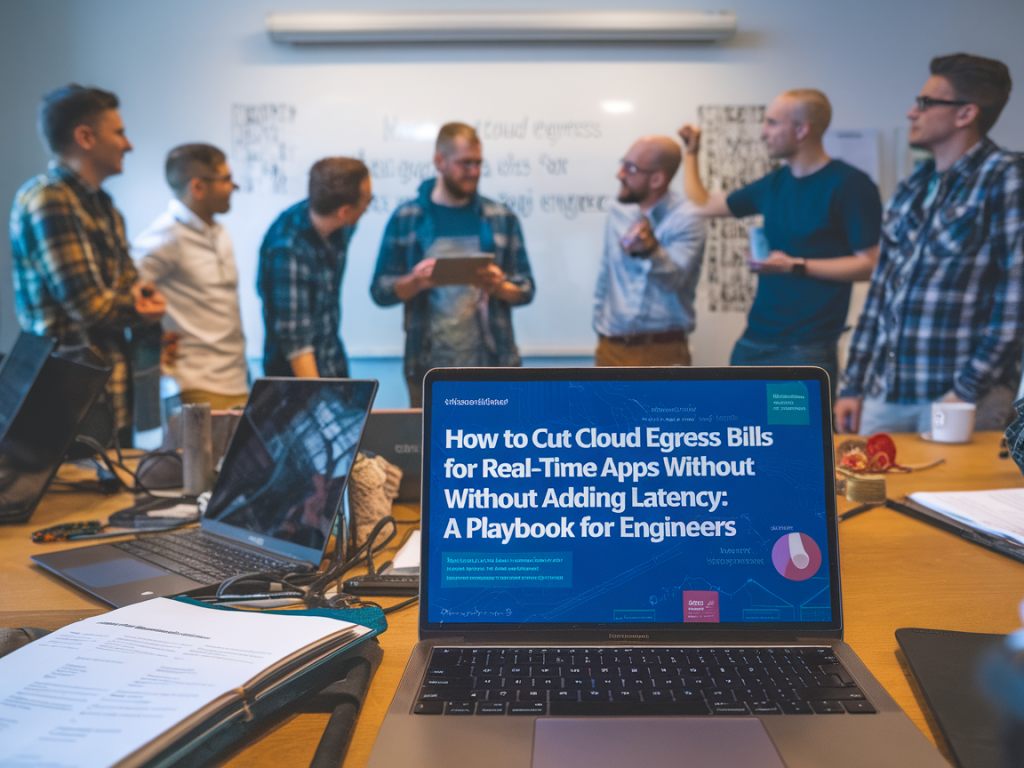
I’ve spent the last few years helping teams build real-time features—live dashboards, multiplayer sessions, collaborative editors—and one thing keeps coming up in post-launch retrospectives: egress bills. Real-time apps are chatty by design, and pushing bits out of a cloud region to end-users can be surprisingly expensive. Worse, many “optimizations” that promise savings actually add latency or complexity that kills the user experience.
In this playbook I’ll walk through practical patterns and trade-offs I’ve used to materially cut egress costs while keeping latency tight. These are engineering-first tactics you can start measuring in days, not quarters: architecture choices, protocol picks, data-shaping techniques, and provider-level levers. I’ll mention specific products where helpful, but the focus is on ideas you can adapt to your stack.
Start by measuring what you actually pay for
Before making changes, you need a clear baseline. Cloud provider invoices hide the details unless you break them down, so spend the first sprint instrumenting these metrics:
Per-region egress volumes (GB) and costsPer-service egress (CDN, app servers, message broker, databases)Per-endpoint or per-customer cost attribution if multi-tenantLatency percentiles (p50/p95/p99) correlated with egress volumeUse provider billing APIs (AWS Cost Explorer, GCP Billing export, Azure Consumption) and wire them into a simple dashboard (Grafana, BigQuery, or a spreadsheet). You’ll be surprised how often a single hotspot—an analytics stream or misconfigured backup—dominates costs.
Edge-first: push logic closer to users
My single biggest win across products was moving compute and caching closer to users so fewer bytes traverse inter-region links.
Use a CDN for dynamic real-time assets: modern CDNs (Cloudflare, Fastly, AWS CloudFront with Lambda@Edge, GCP Cloud CDN) can handle dynamic responses, edge caching short-lived data, and even run tiny transforms. Cache ephemeral but shared assets—avatars, thumbnails, small JSON blobs—at the edge with millisecond TTLs.Adopt edge functions for protocol termination: terminate WebSocket or HTTP/2 upgrades at the edge where possible. This reduces cross-region hops for control frames and lets you handle fan-out locally.Run real-time signaling and presence at the edge: for many apps the heavy data (media or state diffs) is regional. Keep presence and matchmaking logic as close as possible to reduce inter-region egress.Choose protocols that minimize overhead
Protocol overhead matters. Small, frequent messages hurt more than large, sparse ones because TCP/TLS handshakes and headers become a larger fraction of payload.
Prefer WebRTC or QUIC for peer-to-peer and low-latency transport. WebRTC reduces server egress for media and can enable direct client-to-client streams where network topology allows.Use gRPC or HTTP/2 for multiplexing many small streams over a single connection to reduce header overhead and connection churn.Avoid polling: long polling or frequent HTTP polls multiply costs. Use push-based approaches (WebSocket, WebPush, SSE) for realtime signaling.Shape the data: compress, delta, and sparsify
Reducing bytes is obvious but often under-implemented. I prefer small, easy-to-reason techniques that maintain latency.
Apply lightweight binary protocols (MessagePack, CBOR) instead of verbose JSON for high-frequency messages.Send deltas, not snapshots. For collaborative state or telemetry, transmit only changes and where possible compress positional info with integer diffs.Enable compression selectively: Brotli or LZ4 can help. For tiny messages compression can be counterproductive due to CPU overhead—measure!Sparsify updates with intelligent suppression: if you update a UI element at 100Hz but user’s perception stops improving past 30Hz, drop intermediate updates at the sender or edge.Private multicast and fan-out strategies
When many users see the same update, naive fan-out from origin is expensive. Consider these patterns:
Use a managed pub/sub with regional replication (Kafka MirrorMaker, Pulsar, AWS SNS+SQS patterns, Google Cloud Pub/Sub regional endpoints). Publish once and let regional subscribers pull locally.Introduce a broker mesh: an edge/border broker in each region handles local fan-out instead of routing every message through central servers.For browser clients, evaluate WebRTC SFUs or selective forwarding units that accept a single upstream and replicate locally rather than sending N copies from origin.Leverage CDNs creatively for real-time
CDNs aren’t only for static files. I’ve used them for semi-real-time patterns that dramatically reduce origin egress:
Short TTL polling via CDN: serve a JSON “current state” from CDN with a 1–2s TTL. Clients poll the CDN, and only when stale does the CDN fetch from origin. This converts many direct origin hits into cache hits while keeping timeliness.Cache digests or bloom filters: instead of full datasets, serve small digests that clients use to decide if they need a full fetch.Region-aware architectures and multi-cloud considerations
Moving data across regions or cloud providers is expensive. Design for regionality:
Make regions first-class: deploy services to the regions where your users are. Route users to the closest region with DNS geolocation or anycast.Accept eventual consistency across regions for non-critical state to avoid synchronous cross-region egress.If you run multi-cloud, be explicit about inter-cloud ingress/egress. Cross-cloud traffic is often the most expensive—avoid it for high-volume streams.Billing-level levers and contractual optimizations
Negotiate with your provider when you have scale. Providers often give custom egress pricing, especially if you commit to predictable volumes.
Look for CDN or network transfer bundles. Some clouds let you buy a fixed egress quota at lower rates.Use private links or interconnects between commonly communicating clouds/regions. These can be cheaper than public internet egress for sustained traffic.Explore peering and direct connect options with major ISPs in your core markets to reduce public egress costs and improve latency.Operational playbook: test, measure, and iterate
Finally, integrate cost into your CI and SLOs:
Set egress budget alerts (daily/weekly) tied to development branches or feature flags so new features don’t surprise you.Run A/B experiments: enable an optimization (edge caching, compression) for a subset of users and compare latency, CPU, and bill impact.Maintain a lightweight cost model in your repo: what each feature adds in expected GB/day under traffic assumptions. Update it as reality diverges.| Technique | Typical savings | Latency impact |
|---|
| Edge caching dynamic assets | 20–70% | improves |
| WebRTC peer-to-peer | 50–90% for media | improves or neutral |
| Delta encoding + binary protos | 30–80% for high-frequency messages | neutral |
| Short TTL CDN polling | 40–90% depending on overlap | small increase (ms) |
Putting all this together: design for regionality, push work to the edge, choose efficient protocols, and shape your data. Combine quick wins (edge caching, compression, protocol changes) with longer-term architecture shifts (regional brokers, SFUs). If you measure carefully and run controlled experiments, you can cut egress bills by large percentages without sacrificing the low latency your users expect.