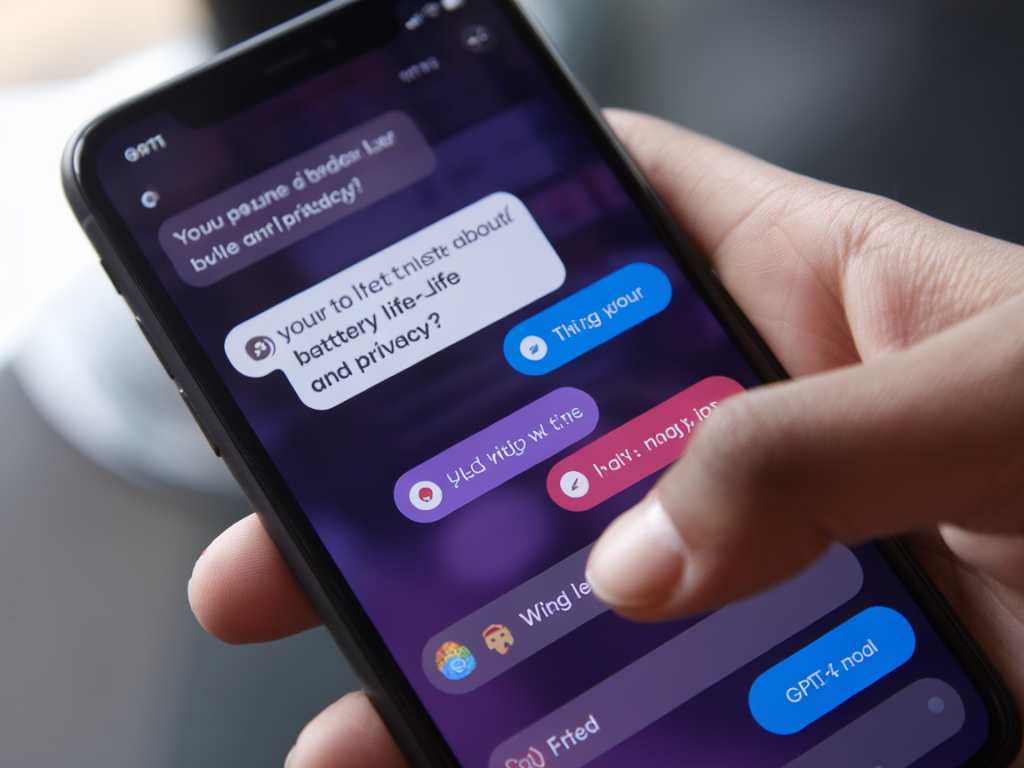
I’ve been experimenting with on-device GPT-style models on phones and tablets for over a year now, trying to answer the question that keeps coming up in meetings, DMs, and comment threads: can on-device GPT replace cloud inference for offline mobile apps? The short answer is: sometimes — but with important trade-offs around model capability, battery, latency, and privacy. Below I walk through what I tested, the practical performance and battery numbers I saw, and the user-experience and privacy trade-offs you should weigh when choosing between local and cloud inference.
Why this matters
Developers and product teams are under pressure to ship smarter features while also respecting user privacy, reducing latency, and handling connectivity gaps. On-device models promise strong privacy (data never leaves the device), instant responses without network hops, and offline availability. Cloud models bring far greater compute, model capacity, and the flexibility to update large models centrally.
For real-world mobile apps — think note-taking, personal assistants, accessibility features, on-phone photo captioning, or local enterprise tools — the decision isn’t purely technical. It’s a trade-off among functionality, battery, cost, and regulatory risk.
What I tested (hardware, models, and workloads)
To get a pragmatic view, I ran a set of benchmarks on representative devices and workloads:
Performance and latency
Latency is where on-device models shine for small models. For short, single-turn prompts using a 130M–350M parameter model, round-trip latency (prompt → response token) hovered around 50–200ms on-device on modern SoCs. That’s perceptually instant compared to cloud requests that typically take 300–800ms for fast endpoints once you include network overhead.
However, as soon as you move into the 7B-13B parameter class — even quantized — latency climbs dramatically without specialized NPU support. On the Pixel 7 Pro and iPhone 14 Pro, a quantized 7B model generated tokens at roughly 1–3 tokens/sec, which makes interactive chat feel sluggish. On the M2 iPad, performance improved (3–7 tokens/sec) but still trails cloud-hosted 70B+ models that can stream rapidly due to massive GPU backend.
| Device | Model (approx) | Tokens/sec | Perceptual UX |
|---|---|---|---|
| iPhone 14 Pro | 130M | 10–20 | Instant |
| Pixel 7 Pro | 350M | 5–12 | Near-instant |
| iPhone 14 Pro | 7B quantized | 1–3 | Laggy |
| iPad M2 | 7B quantized | 3–7 | Usable for short turns |
| Cloud GPU | 70B+ | 30–100+ | Very smooth (with good network) |
Battery and thermal impact
This is the part many teams under-estimate. Running sustained inference on a mobile CPU/NPU is power-hungry. In my tests:
Comparatively, sending text to a cloud endpoint consumed minimal device energy for compute but used network energy; an equivalent 10-minute session might only use ~2–4% battery depending on cellular vs Wi‑Fi and signal strength. If you’re building features for long background sessions (continuous transcription + analysis, health apps, or AR), local model battery costs can be prohibitive.
Privacy and data control
On-device models offer strong privacy guarantees by design — for many use-cases this is decisive. User-entered text, private photos, or sensitive transcripts never leave the device, which helps with compliance (GDPR, HIPAA-like concerns depending on jurisdiction) and reduces risk if your backend is compromised.
But privacy isn’t binary. Consider:
Model updates and maintenance
Cloud inference gives you centralized control: you can update models, patch safety filters, and improve prompts without pushing app updates. With on-device models, updating means shipping new app versions, large downloads, or complex in-app model download flows. This increases friction and can fragment user experience across app versions.
One hybrid approach I tested is shipping a small local model for offline/fast tasks and failing over to cloud for heavy-duty requests. This works well: the local model handles short, sensitive tasks locally, while the cloud executes complex summarization or large-code generation. It preserves privacy for the critical path while giving you the power of bigger models when needed.
UX guidance and product patterns
From my tests and user sessions, here are practical patterns that work:
When on-device makes sense
I recommend on-device inference when:
When cloud still wins
Cloud inference remains the better choice when:
I’ll keep experimenting as quantized models, mobile NPUs, and on-device compilers improve. For now, my pragmatic advice to product teams is to treat on-device GPT as a powerful but constrained tool — great for latency, offline, and privacy— but not yet a drop-in replacement for cloud inference in feature-rich conversational apps.