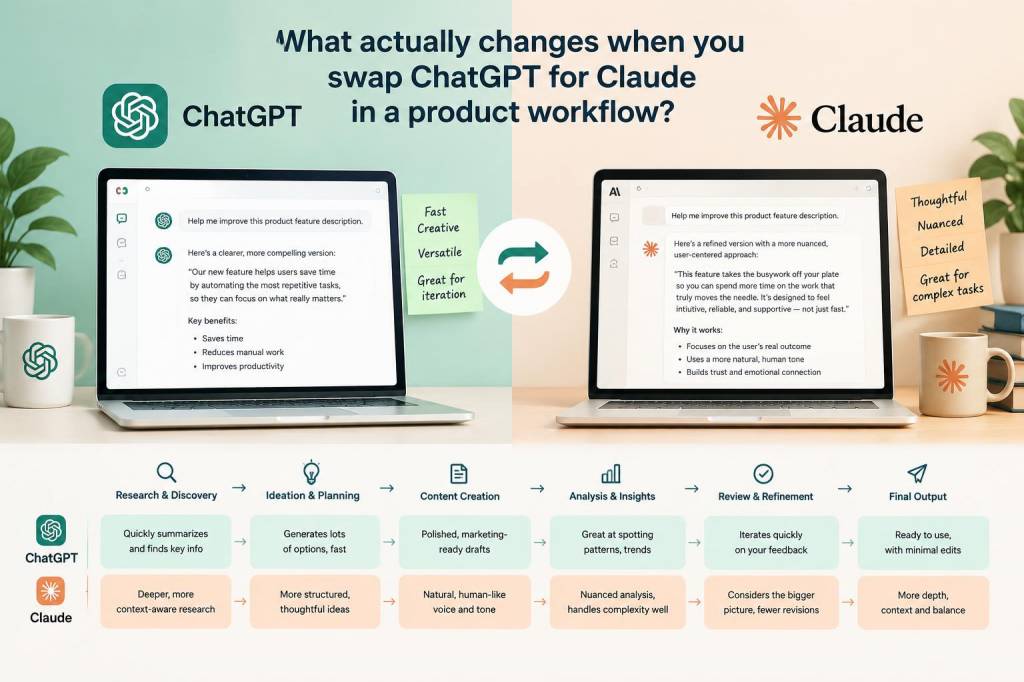
When I swap ChatGPT for Claude inside a product workflow, I do not feel like I am changing a simple tool. I feel like I am changing a working style. On paper, both systems help with writing, analysis, coding support, research synthesis, and brainstorming. In practice, each one pushes a team toward different habits, different assumptions, and different levels of trust in the output. That difference matters once an AI tool moves from a casual assistant to something that touches planning, customer-facing text, internal operations, or product decisions.
I have seen teams treat model choice as a cosmetic decision, when it is often a workflow decision. If a product manager asks for a feature brief, a support lead wants a response draft, or a content team needs a first pass at an article, ChatGPT and Claude can both help. Still, once I start using one or the other every day, I notice changes in pacing, tone, revision patterns, context handling, and even team confidence. Those changes affect more than output quality; they affect adoption.
What changes first: tone and drafting style
The first thing I notice is tone. ChatGPT often feels more flexible in style switching. I can push it toward concise business language, technical explanation, casual marketing copy, or structured bullet-heavy output, and it usually adapts quickly. Claude often feels more naturally polished in long-form drafting, with a smoother voice and a more reflective rhythm. When I ask for a memo, policy summary, or product narrative, Claude often gives me something that already sounds close to an edited draft.
That difference changes my workflow because it changes how much rewriting I do. With ChatGPT, I often spend more time shaping the voice. With Claude, I often spend more time checking whether every claim is specific enough and whether any useful detail got softened in a very polished sentence. In one case, I am editing for voice. In the other, I am editing for precision.
For product teams, that difference can matter a lot. A support team may prefer a model that gives clean, empathetic replies with less prompting. A growth team may prefer a model that can rapidly produce several tones for testing. A product strategist may prefer whichever model delivers a draft that is easier to refine into an internal recommendation.
What changes in context handling
Context handling is where workflow changes become much more noticeable. In long product discussions, I care about whether a model can hold onto constraints, user segments, feature lists, risk notes, and prior decisions without drifting. Claude often feels strong when I feed it long documents, meeting notes, specs, or research packets and ask it to preserve a consistent thread across a long response. That can be especially useful when I want a model to summarize a dense product history or compare several stakeholder positions.
ChatGPT can also handle long context well, but I notice that I often use it more iteratively. I give it a chunk, get a draft, refine the prompt, then move to the next layer. That makes ChatGPT feel excellent for interactive exploration. Claude can feel more like a thoughtful reader of a large brief, while ChatGPT can feel more like a rapid collaborator in a back-and-forth session.
In practice, I adjust my workflow accordingly:
- With Claude, I tend to upload more context upfront and ask for a coherent synthesis.
- With ChatGPT, I tend to break work into shorter cycles and use follow-up prompts to sharpen direction.
- With either model, I still verify details myself before anything goes into a product doc, customer message, or release note.
What changes in ideation
When I need ideas, ChatGPT usually feels more expansive. It is often very good at producing lots of variants fast: feature concepts, naming directions, content angles, onboarding ideas, experiment hypotheses, or customer segment assumptions. That makes it useful when a team is still exploring possibilities and needs volume before selection.
Claude, in my experience, often gives fewer but more developed ideas. Instead of flooding me with ten loose concepts, it may give me a smaller set with clearer logic behind each one. That can be more valuable when I want to move from brainstorming into planning. I spend less time filtering and more time evaluating.
This shifts the shape of a session. When I use ChatGPT, I often leave with raw material. When I use Claude, I often leave with a more organized draft of direction. Neither is universally better. They support different phases of product work.
What changes in analysis and reasoning
Product workflows often involve judgment, not just generation. I want a model to compare trade-offs, surface risks, identify gaps in evidence, and explain why one option may be stronger than another. This is where I notice nuanced differences.
Claude often feels especially strong at careful, linear explanation. If I ask it to compare two onboarding flows, assess a pricing page change, or review a product requirement for ambiguity, it tends to produce a measured response that respects nuance. It often reads like a patient analyst who wants to avoid overclaiming.
ChatGPT can be excellent here as well, but I often push it harder to stay anchored. I ask for assumptions, edge cases, examples, or counterarguments. Once I do that, it can produce very useful reasoning, especially when I want structured options or decision trees. It often feels more interactive in a debate-like sense, which can be useful when I want to challenge an idea from multiple angles.
For product work, that means my prompt style changes. With Claude, I may ask for a deep synthesis from a larger packet. With ChatGPT, I may ask for a framework, then probe each branch with follow-up questions.
What changes in coding support
When I use either model for coding help, I care less about brand loyalty and more about friction. ChatGPT often excels when I want quick prototype assistance, syntax help, debugging suggestions, or a fast explanation of why something failed. Claude can be very strong when I want it to read a broader code context and reason through architecture or refactoring choices with care.
In a product workflow, that difference matters because coding help is not just about writing code. It is about reducing interruption. If I am working on a feature ticket and I need a fast answer, I may prefer the model that gets me unstuck quickly. If I am reviewing a larger design decision, I may prefer the model that reads the broader context more carefully and produces a cleaner narrative of what needs to change.
What I notice most is that Claude often encourages a more deliberate review process, while ChatGPT often encourages faster iteration. A fast iteration loop is useful for prototypes. A deliberate review loop is useful for maintainable systems.
What changes in product operations
Once an AI assistant enters real product operations, small differences become operational differences. A support workflow needs consistency. A product marketing workflow needs tone control. A planning workflow needs traceability. A knowledge workflow needs clear source boundaries. I have found that model choice can subtly alter each of those.
For example, if a team uses ChatGPT for customer reply drafts, they may get more stylistic variety and faster experimentation. If they use Claude, they may get more consistently polished replies with less manual cleanup. If a team uses ChatGPT for feature ideation, they may get broader exploration. If they use Claude for internal synthesis, they may get more disciplined summaries.
That sounds small until it scales. Over a week, a team can build habits around one model’s strengths. Over a quarter, those habits shape documentation quality, review speed, and even what kinds of questions people remember to ask.
| Workflow area | ChatGPT often feels like | Claude often feels like |
|---|---|---|
| Drafting | Flexible, fast, highly steerable | Polished, calm, coherent |
| Ideation | Broad, high-volume, exploratory | Selective, structured, considered |
| Long context | Strong with iterative prompting | Strong with large context synthesis |
| Reasoning | Interactive, improv-friendly | Measured, careful, analytical |
| Coding support | Quick unblocker | Deliberate reviewer |
What changes in team behavior
The model also changes human behavior. That part is easy to miss. If a model gives confident answers too quickly, people may stop checking enough. If a model is too cautious, people may stop using it as often. I pay attention to how each one influences trust. Trust is not just about accuracy; it is about whether a team feels invited to verify, challenge, and refine.
ChatGPT can make a workflow feel lively and experimental. That is great for creative exploration, but it can also encourage rapid consumption of output. Claude can make a workflow feel more considered and document-oriented. That is great for careful synthesis, but it can also slow down very fast-moving teams if people wait too long for a perfectly shaped response.
So when I swap one for another, I do not just ask, “Which answer is better?” I ask, “What behavior does this model encourage in my team?” If the answer is more experimentation, that may be exactly what I want. If the answer is more discipline, that may be better for a high-stakes workflow.
What changes in my own prompt habits
My prompting style changes almost immediately. With ChatGPT, I tend to be more directive and iterative. I may say what I want, then refine, then narrow, then ask for alternatives. With Claude, I often provide a more complete brief at once because it rewards fuller setup with a more unified response. I also find myself asking Claude to preserve structure, tone, and constraints from the start.
That means swapping models is not a neutral action. It asks me to adapt. If I do not adapt, I sometimes misread the model’s strengths. A sparse prompt can waste Claude’s ability to synthesize well. A very long prompt can slow down ChatGPT when a shorter iterative exchange would have been more efficient.
So my habit is to match the prompt to the model and the task:
- For ChatGPT, I often use short cycles, rapid correction, and multiple variants.
- For Claude, I often use fuller context, a clear objective, and a request for synthesis.
- For both, I ask for assumptions, risks, and source boundaries when accuracy matters.
What changes in output quality from a product lens
From a product lens, output quality is not only about eloquence or factual correctness. It is about usefulness inside a workflow. A model can be brilliant and still be a poor fit if it creates extra revision, encourages vague thinking, or slows the team down. A model can be less flashy and still be a better fit if it helps people move from question to decision more efficiently.
That is why I see ChatGPT and Claude as complementary rather than interchangeable. ChatGPT often helps me move quickly from blank page to momentum. Claude often helps me move from rough material to coherent structure. In a real product environment, those are distinct jobs. I may start with one and finish with another. I may even use both on the same task: one for breadth, one for refinement.
What actually changes, then, is not only what I get back. What changes is how I think, draft, review, and decide while using it. That is why swapping ChatGPT for Claude in a product workflow feels less like changing a vendor and more like changing a teammate’s working style.