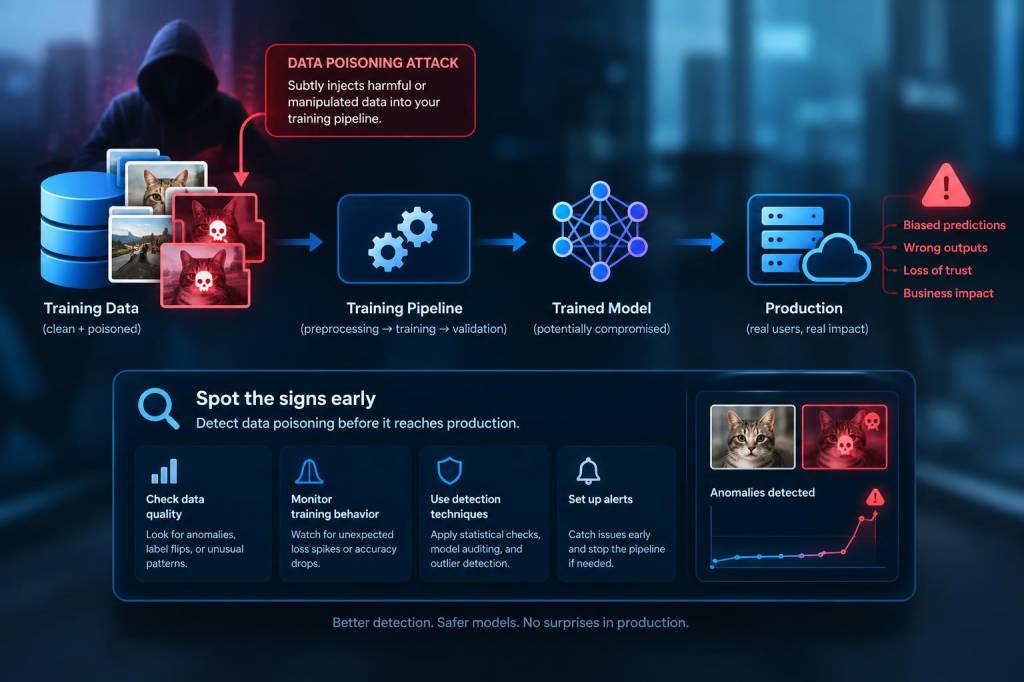
Data poisoning is one of those threats that feels both abstract and terrifying: an attacker doesn't need access to your production model to ruin it — they only need to slip malicious or low-quality examples into a training dataset upstream. I've seen pipelines fail in subtle ways after retraining with tainted data, and the worst part is that the damage often looks like "just noise" until it's too late. Below I walk through pragmatic, hands-on steps I use to spot data-poisoning attacks in a training pipeline before they make it into production models.
What data-poisoning attacks look like in practice
Before we get to detection, it's useful to review the most common poisoning strategies so you know what to hunt for:
Label flipping — attackers flip labels (e.g., dog -> cat) for a subset of examples so the model learns incorrect associations.Backdoor (trigger-based) attacks — clean-looking inputs with a hidden "trigger" (a pixel pattern, a sticker in images, a particular token in text) cause the model to output attacker-chosen predictions.Clean-label attacks — crafted inputs that look legitimate but are optimized to influence decision boundaries subtly.Availability poisoning — noisy or duplicated examples that degrade generalization and reduce model performance.Each type leaves different fingerprints in data and model behavior; a layered detection approach catches more of them.
Baseline hygiene: dataset provenance and versioning
The first and most effective line of defense is simply knowing where your data came from and how it changed.
Enforce strict provenance: Log source, collection time, uploader identity, and ingestion path for every example. Systems like DVC, MLflow, or Pachyderm are invaluable here.Immutable storage and checksums: Store raw uploads in immutable object storage and save cryptographic hashes (SHA-256). Any later change should be auditable.Dataset versioning: Tag dataset snapshots used for each model training run. That way you can compare "good" vs "bad" snapshots and revert easily.Automated data validation gates
Manual checks don't scale. I always run automated data quality gates before any training job starts.
Schema checks: Validate types, ranges, and required fields. Great Expectations or open-source TensorFlow Data Validation (TFDV) both work well.Distributional checks: Monitor feature distributions and label frequencies. Raise alerts when a feature's mean/variance or a label proportion deviates beyond thresholds.Uniqueness and duplication: Detect suspicious duplicates or near-duplicates — mass duplication often hints at poisoning or ingestion bugs.Provenance-based rules: Block training if new data comes from untrusted sources or if uploader metadata is missing.Label integrity and quality signals
Label-targeted attacks are common — so check labels explicitly.
Cross-validation label checks: Use multiple labeling sources when possible (crowdsourcing + model-assisted labels). Conflict between labelers is a red flag.Model agreement tests: Compare labels against predictions from an ensemble of previously validated models. Sudden increases in label-model disagreement point to label flips or clean-label attacks.Noise and confusion matrices: Track per-class precision/recall over time. If class A's precision collapses while others stay stable, the data for A is suspect.Train-time and model-centric detection
Some poisoning signals only appear when you actually train a model — so include model-centric diagnostics in the CI pipeline.
Holdout and sentinel sets: Maintain a small, strictly controlled validation set (a sentinel) that is never touched by new ingestion. If model performance on the sentinel drops while training-set metrics look fine, suspect poisoning.Influence estimation: Use influence functions or Cook's distance-inspired metrics to find training examples with disproportionate effect on loss. Tools like robust-influence or implementations based on TracIn can help identify high-leverage examples to review.Activation clustering: For neural networks, cluster activations in later layers. Backdoor attacks often cause distinct activation clusters for triggered examples despite diverse inputs.Outlier detection in embedding space: Project inputs into embedding space and flag low-density points. k-NN or isolation forest applied to embeddings catches anomalies that scalar feature checks miss.Behavioral tests and trigger hunting
For backdoors and targeted attacks, you need to probe model behavior actively.
Input perturbation tests: Apply small, systematic perturbations to inputs to see if a specific perturbation flips the label consistently — that's a classic backdoor signature.Canary examples: Insert known synthetic "canaries" into controlled parts of the pipeline (with unique, detectable tokens or patterns) to detect unauthorized propagation or manipulation.Adversarial search: Run targeted searches for triggers: for images, tiny patches or sticker-like patterns; for text, rare tokens or punctuation patterns. Libraries like CheckList (for NLP) can be adapted to this.Monitoring and alerting in pre-production and after deployment
Detection is continuous. Your CI/CD pipeline and production monitoring should talk to each other.
Pre-deploy gates: Fail deployment if new model shows statistically significant performance regressions on the sentinel or if data checks flagged anomalies.Shadow deployments: Run new models in shadow mode on live traffic and compare outputs to the current model. Divergences in specific segments often reveal poisoning that slipped past training checks.Post-deploy monitoring: Track per-segment error rates, prediction distributions, and feature drift. Pair model telemetry with data lineage — if a particular data source correlates with bad predictions, isolate it.Operational checklist (practical, repeatable checks)
Here’s a compact set of checks I run automatically for each training run. You can implement these as CI steps.
| Check | Why | Action if failed |
| Provenance metadata present | Prevents unknown sources | Block ingestion; require human review |
| Checksum matches snapshot | Detects tampering | Reject dataset; investigate commit history |
| Label distribution within tolerance | Detects label flips | Alert + sample review |
| Sentinel performance unchanged | Catches stealthy attacks | Abort training; run influence analysis |
| Embedding outlier rate low | Finds anomalous examples | Quarantine flagged examples |
Tools and libraries that help
There’s no single silver bullet, but these tools accelerate defenses:
Great Expectations / TFDV: Schema and distribution checks.DVC / MLflow / Pachyderm: Provenance and dataset versioning.Evidently / Fiddler / WhyLabs: Drift and model monitoring in production.Robustness libraries: Adversarial-robustness-toolbox (ART) has poisoning and backdoor detection utilities.Custom scripts: Influence function implementations, activation clustering scripts, and embedding outlier detectors. These are often the most practical to tailor to your model family.Cultural and process controls
Technical measures won't work without process and people:
Least privilege for data writes: Limit who can add training data and require multi-person signoff for unknown sources.Labeling audits: Periodic random audits of labeled data, and ongoing agreement checks between human and model labels.Incident playbooks: Have a runbook that defines steps (revert dataset snapshot, isolate model, forensics) when a poisoning alert fires.Data poisoning is a blend of adversarial ML, software integrity, and classic operational security. The good news is that many signals of poisoning are detectable with discipline: provenance, automated validation, sentinel sets, influence analysis, and proactive behavioral tests form a layered defense that catches most known attack types. Start by instrumenting provenance and validation; you can add heavier model-centric analyses once you have that foundation in place.