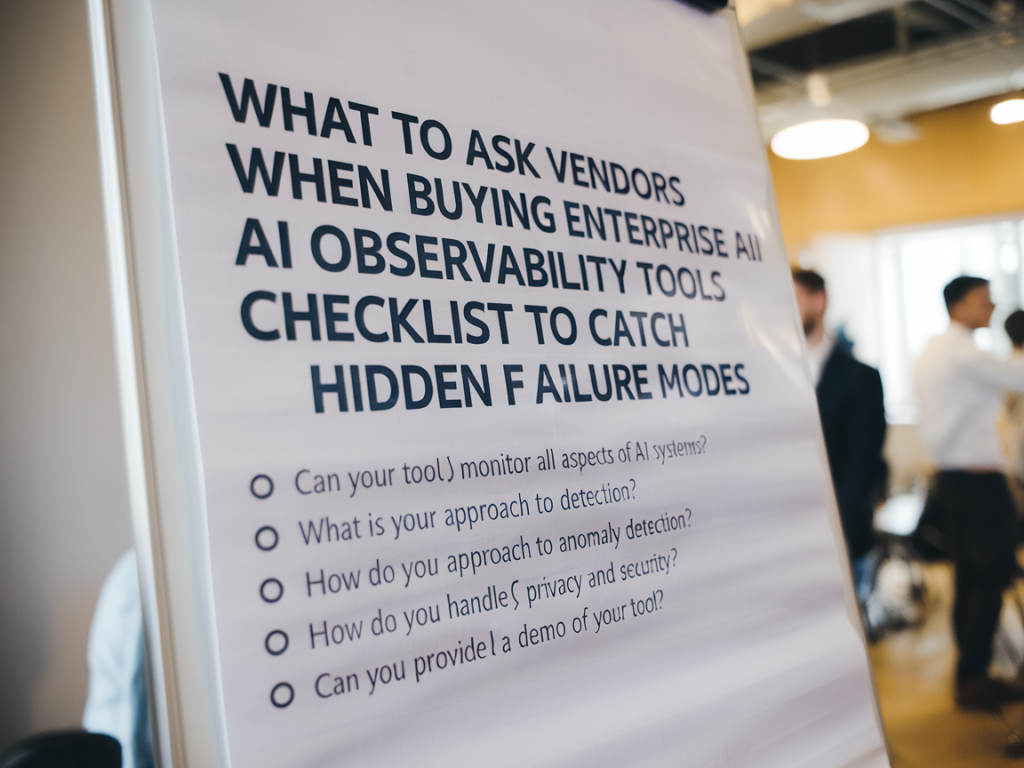
Buying an enterprise AI observability tool is one of those decisions that looks simple on a feature sheet and quickly becomes painful in production. I’ve sat in more vendor demos than I’d like to admit, built my own ad‑hoc monitoring stacks, and seen observability gaps turn into customer incidents. The checklist below is meant to help you ask the right questions in procurement conversations so you don’t discover hidden failure modes after rollout.
Start with what you actually need — define the observable outcomes
Before you interrogate vendors, get clear on what “success” looks like for your org. Are you trying to catch data pipeline breakages, detect model performance degradation, avoid bias in decisions, reduce false positives, or meet regulatory audits? Different tools emphasize different parts of the stack: logs/metrics/traces, MLOps model telemetry, data observability, behavioral explainability, or synthetic testing.
Tell the vendor your top 3-5 outcomes and ask them to map features to those outcomes. If they can’t, that’s a red flag.
Core technical questions to ask every vendor
- What telemetry does your agent/SDK collect by default? Metrics, traces, logs, model inputs/outputs, feature distributions, gradients, inference latency, request context?
- Can we control sampling and retention? Full capture is expensive. Ask about configurable sampling policies (per model, per user segment, per feature) and retention tiers.
- How do you handle high-cardinality data? Many production workloads have millions of unique keys. Ensure the vendor scales without cardinality explosion or provides aggregation strategies.
- What integrations exist with our stack? Feature stores (Feast), data warehouses (BigQuery, Snowflake), orchestration (Airflow, Kubeflow), model registries (MLflow), observability platforms (Datadog, Honeycomb), and SIEMs. Ask for specifics and demo connectors.
- Is the agent synchronous or asynchronous? For latency-sensitive inference, synchronous telemetry can add tail latency. Vendors should offer async or out-of-band collection.
Questions specifically about detecting hidden failure modes
Hidden failures are subtle: model skew, silent data corruption, upstream schema drift, or unexpected user behavior. These are the ones that bite you at 2am.
- How do you detect data drift vs. distribution shift? Ask for concrete algorithms (KS-test, population stability index, KLD, multivariate tests) and whether they alert on concept drift (label drift) separately from input drift.
- Can you detect feature leakage or sudden covariate correlations? Some platforms surface rising correlations between features and labels that indicate leakage or changing relationships.
- How are label delays handled? Many production systems only get ground truth days or weeks later. Vendors should support delayed-label evaluation and backfilled metrics.
- Do you provide counterfactual or counterexample search? Being able to query “show me inputs that produce high error” is critical for root cause analysis.
- What synthetic and adversarial testing capabilities do you offer? Can you simulate shifts, adversarial inputs, or targeted edge cases to validate robustness?
Alerts, SLOs, and reducing alert fatigue
Too many alerts kill trust. The vendor should help you craft meaningful signals.
- How do you define and evaluate SLOs for model behavior? Does the tool support error budgets, golden datasets, or business-level KPIs?
- Can alerts be contextualized with runbook links and recent telemetry? An alert that points to the offending feature distribution, recent schema change, and a suggested remediation is far more useful.
- Do you support suppression, deduplication, and severity scoring? Look for features to reduce noise and prioritize incidents.
Root cause analysis and observability workflows
Observability is only useful if you can quickly get from an alert to a fix.
- How do you support drill‑down analysis? Time-series charts are fine, but you need tracebacks to specific inferences, cohort analysis, and the ability to replay inputs.
- Is it possible to replay or reprocess captured requests? Replaying requests with a previous model version or modified preprocessing helps isolate whether the model or upstream data changed.
- Can you preserve reproducibility and lineage? Record model version, feature transform code, dataset snapshot, and config used for each inference.
- Do you provide automated root-cause hints? Some tools surface likely causes (population skew in feature X, upstream nulls, code deploy). These hints shouldn’t replace human analysis but speed it up.
Explainability, fairness, and auditability
Regulators and customers increasingly demand explainable decisions and bias controls.
- Which explainability methods do you support? SHAP, LIME, counterfactual explanations, local surrogate models? Ask about performance and limitations at scale.
- Can you measure fairness metrics over time across protected groups? Demographic parity, equalized odds, false positive/negative rates by cohort.
- How do you store and export audit trails? The platform should produce immutable logs that show which model/version/feature set produced a decision and who approved changes.
Security, privacy, and compliance
Telemetry often contains PII or sensitive attributes. Don’t let observability become a data-leak vector.
- Where is data stored and processed? Cloud regions, on‑prem options, or hybrid? Can we restrict storage to our VPC?
- Do you support encryption at rest and in transit, and customer-managed keys?
- Are there PII masking and schema redaction features? Vendors should let you redact or hash sensitive fields before ingestion.
- What are your certifications? SOC2, ISO27001, GDPR compliance details, and contractual terms around data ownership.
Operational concerns: scale, cost, and deployment
- How does pricing scale? Per-host, per-model, per-inference, per-data-row? Ask for pricing examples using your actual traffic and cardinality assumptions.
- What are typical ingestion and storage costs for our volume? Get a TCO estimate for 3–12 months of expected telemetry.
- How do upgrades and schema changes work? Can they introduce breaking changes? What is your backward compatibility policy?
- Is the system multi-tenant and does it support strict tenancy isolation? This matters for managed services used across business units.
People and process: support, SLAs, and onboarding
- What does onboarding look like? Time to first meaningful alert or dashboard? Ask for a prescriptive integration plan for your stack.
- Do you provide runbooks, playbooks, or SRE partnerships? Some vendors help you codify mitigation steps and tune alerts for your use cases.
- What SLAs and support levels are offered? Uptime, data retention guarantees, and escalation paths.
- Can you supply reference customers in our domain? Hearing war stories from similar deployments is invaluable.
Hands-on evaluation checklist (what to include in a POC)
| POC scenario | Why | Success criteria |
| Ingest live inference stream (sampled) | Test latency, sampling, and cardinality | System accepts traffic without adding >5ms median latency |
| Inject synthetic drift | Validate drift detection and alerting | Drift detected within expected window and alert includes affected features |
| Replay historical failure cases | Assess root cause workflows | Platform surfaces cohort of failing inputs and supports replay |
| Check explainability at scale | Measure cost and clarity of explanations | Results produced within SLA and are human-interpretable |
| Test PII redaction | Compliance requirement | No raw PII stored in vendor system |
In my experience, the vendors that win long‑term are the ones that treat observability as a full lifecycle problem—not a dashboard checkbox. They help you define meaningful signals, integrate with your pipelines, and provide low‑friction workflows for investigation and remediation. Tools that only surface charts without lineage, replay, or strong privacy controls tend to become a noisy expense rather than a safety net.
Finally, insist on a realistic POC that mirrors your real traffic, cardinality, and label latency. If a vendor can’t demonstrate value on your data within a short pilot, they probably won’t be the partner you need when the subtle failures start manifesting in production.