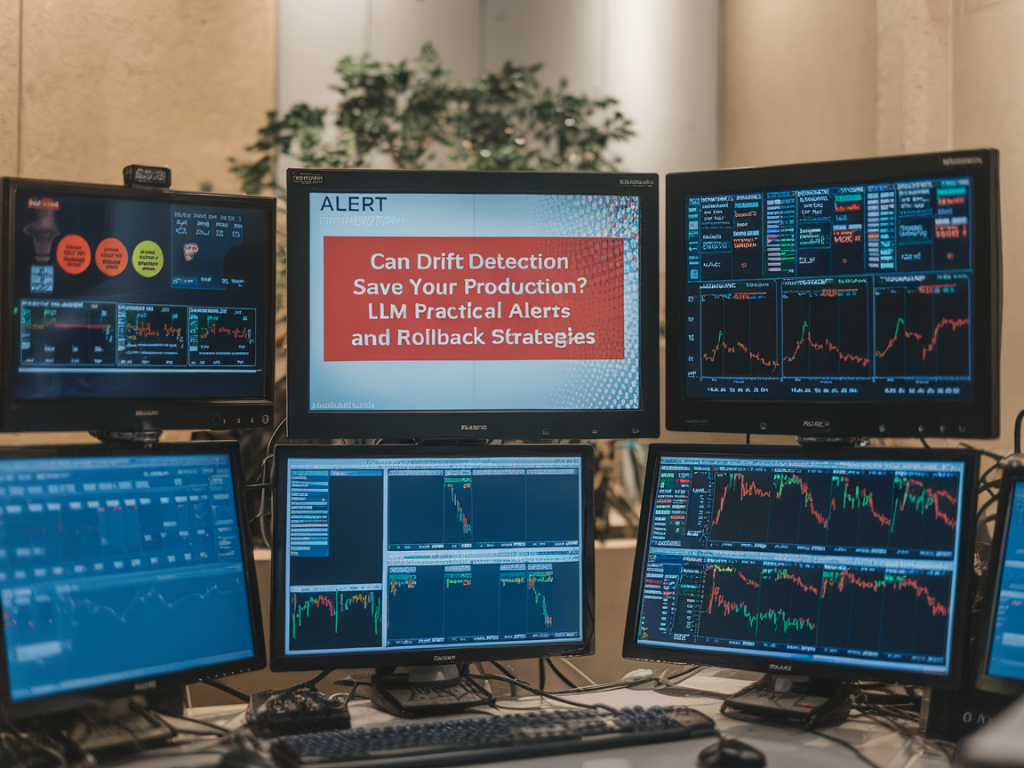
Keeping a large language model (LLM) healthy in production feels a bit like tending a high-maintenance houseplant: ignore it for too long and it wilts, water it too much and you drown it. In the last few years I’ve watched teams move from “deploy and forget” to continuous monitoring and active mitigation — and the single most effective lever I've seen is drift detection. But drift detection isn’t a magic wand; it’s a practical system that must be paired with sensible alerting, human workflows, and rollback strategies. Here’s how I approach it in real-world systems.
What do we mean by “drift” for LLMs?
When people say “model drift” they often mean different things. I mentally split drift into two categories:
Data (input) drift: the distribution of incoming requests changes. Examples: new vocabulary, a spike in a locale, or a shift from short queries to long-form prompts.Concept (label/behavior) drift: the model’s relationship between input and desired output changes. This might happen when user intent evolves, new facts become relevant, or your evaluation metric no longer aligns with business goals.For generative LLMs, we also need to consider response drift: the model produces outputs that are less accurate, more toxic, or otherwise lower-quality compared to historical baselines.
Which signals should you monitor?
Not every signal is worth an alarm. Here are the ones I instrument first, ranked by the impact they’ve had in my projects.
Input feature statistics: token length, token frequency, language, presence of new tokens or out-of-vocabulary rates. These are straightforward with tokenizers and histograms.Embedding distribution shifts: track mean and covariance of embeddings for incoming prompts and compare with baseline using Mahalanobis distance or Wasserstein distance.Output quality proxies: perplexity or log-likelihood under a reference model, or model confidence scores when available.Downstream metrics: business KPIs like click-through, conversion, or user satisfaction signals (thumbs-up/down). These are the most important but often delayed and noisy.Safety & policy flags: frequency of toxic content matches, hallucination detectors firing, or policy constraint violations.Latency and error rates: infra signals — increases here often correlate with degraded responses or truncated outputs.Designing practical alerts
An alerting system is only useful if it reduces uncertainty and aids action. I prefer a layered approach:
Informational alerts: small but consistent drift in input token distribution or embedding distance. These go to analytics channels and should not automatically trigger rollback.Actionable alerts: upticks in perplexity, safety violations, or sudden shifts in embeddings beyond a configured threshold. These notify on-call and product owners.Critical alerts: degradation in downstream KPIs or a correlated surge across multiple quality metrics. These should trigger immediate mitigation playbooks (rate limit, canary rollback, escalate to SRE/ML engineer).Alert fatigue is real. I set multi-trigger conditions (e.g., embedding shift + perplexity increase + >1% drop in user rating) before firing high-severity alerts. Tools I’ve used for this include Prometheus + Alertmanager, Grafana alerts, and Datadog — paired with Slack or PagerDuty for routing.
Thresholds and statistical tests
Choosing thresholds is both art and science. Start with historical baselines and adopt statistical tests for robustness:
K-S test: for continuous feature distributions (token lengths, scores).Population Stability Index (PSI): common in production for tracking distributional shifts over time.Wasserstein / Earth Mover’s Distance: useful for embeddings.Control charts (CUSUM, EWMA): detect persistent small shifts that might otherwise be missed.One practical trick: use rolling windows and require drift to persist over N intervals (e.g., 3 consecutive 1-hour windows) before increasing alert severity. This reduces false positives caused by transient traffic bursts.
Immediate mitigation patterns
When an alert fires, teams need deterministic and fast remediation actions. I rely on this tiered set of mitigations:
Traffic shaping: reduce traffic to the new model version, promote a known-good model, or route a fraction of requests to a shadow/backup endpoint.Canary rollback: automatically cut the canary replica if quality metrics drop beyond a threshold.Input sanitization: apply pre-processing filters that normalize inputs (language detection, profanity filters, prompt templates) to reduce bursty variance.Rate limiting: throttle suspicious or anomalous request patterns that might cause degraded behaviour.Human-in-the-loop: route uncertain cases to reviewers and use that feedback to update thresholds or retrain.Automated rollback: how aggressive should you be?
I’ve seen two extremes: entirely manual rollback (slow, safe) and fully automated rollback based on single-metric triggers (quick but risky). My recommendation: semi-automated rollback with safety checks.
Trigger conditions: combine a short-term severity condition (e.g., immediate safety violation rate > X) with an aggregate window check (e.g., downstream KPI change sustained for 30 minutes).Cool-off period: after rollbacks, freeze auto-promotions and require human sign-off for redeployments of the same model version.Observability during rollback: maintain shadow logging and keep the failed model live briefly for debugging — do not fully destroy telemetry until post-mortem is done.Deployment patterns I use
These are the deployment strategies that make drift detection actionable:
Canary releases: send a small percentage of traffic to the new model and monitor the same metrics. Scale up only when metrics are stable.Shadow testing: run new models in parallel to production without affecting user experience. This is invaluable for detecting concept drift before it hits users.Progressive rollouts with kill switches: automated scale-up scripts that rollback automatically if multi-metric alerts occur.Label delay and feedback loops
One of the hardest problems is delayed labels: you won’t know if an answer was correct for hours or days. I handle this by combining fast proxies (perplexity, safety detectors) with sparse but high-quality human feedback. Use online-learning-friendly pipelines or fine-tune on batches, not instant updates, to avoid reinforcing noise.
Operational checklist
Here’s a compact checklist I keep handy for production LLMs:
Instrument token and embedding distributions.Establish baseline metrics and acceptable ranges.Implement multi-signal alert rules and severity tiers.Run canary + shadow deployments for every model change.Provide on-call playbooks for rolling back vs. throttling.Log decisions and retain telemetry for post-mortems.Continuously retrain or refine prompts based on human feedback.Sample alert mapping
| Signal | Severity | Immediate action |
| Embedding distance > threshold | Informational | Notify analytics, increase sampling for review |
| Perplexity spike + safety flags | Actionable | Route traffic to fallback, notify ML engineer |
| Downstream KPI drop > 5% & sustained | Critical | Automated rollback to last good model, trigger incident |
In practice I rely on a mix of open-source and managed tools: Seldon or Cortex for model serving, Prometheus/Grafana for metrics, OpenTelemetry for traces, and simple data pipelines that snapshot embeddings to a data lake for drift analysis. Model evaluation libraries and drift detectors like Alibi Detect or River can speed up prototyping.
Drift detection won’t save a model that was never aligned with product needs, but it will give you early warning and the operational muscle to act fast. The combination of robust instrumentation, sensible alerting thresholds, and pragmatic rollback policies is what turns drift detection from academic curiosity into production-grade insurance.