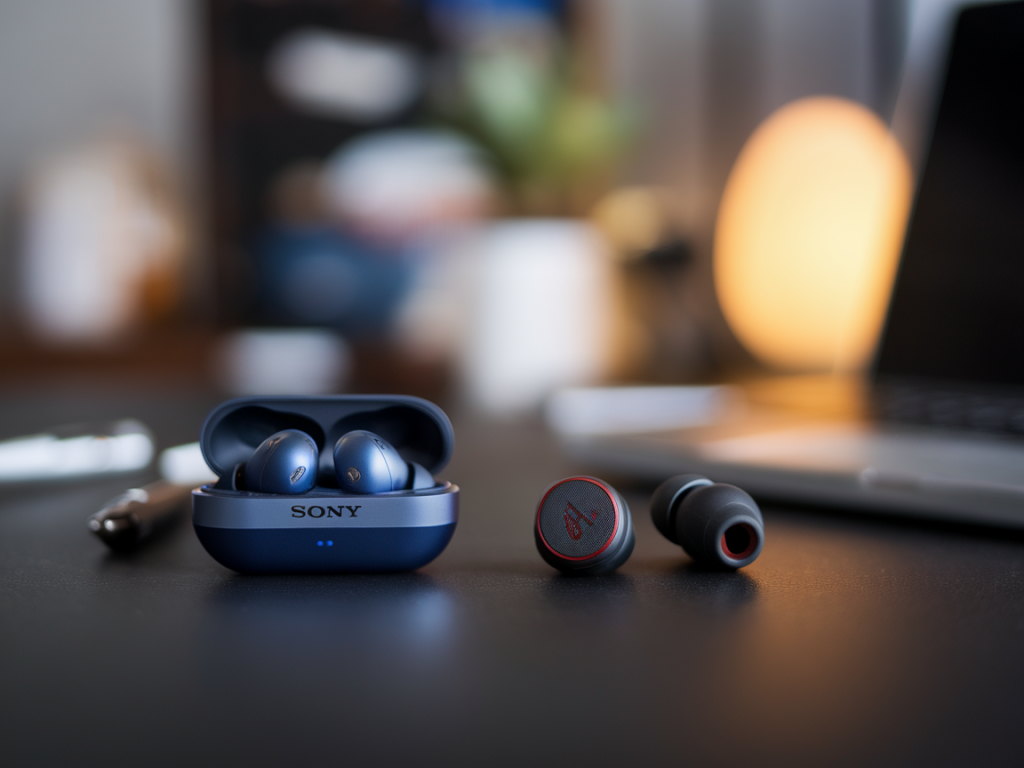
I’ve spent the last few weeks alternating between my living room, a noisy coffee shop, and a shared office desk, testing several budget AI noise-cancelling earbuds against my long-time reference: the Sony WH-1000XM4. The question I wanted to answer was simple but practical: can cheap AI earbuds realistically replace a pair of premium over-ear headphones for hybrid work? Spoiler: the answer depends on what you value—portability and hands-free convenience often win, but there are trade-offs in comfort, battery life, and consistent noise suppression.
What I tested and why
I focused on earbuds advertised with “AI noise cancelling” or “AI-enhanced ANC” features. These included models from several budget-focused brands that frequently pop up on ecommerce marketplaces and a couple of mid-range contenders that bridge price and performance. For baseline comparison I used my Sony WH-1000XM4 headphones, a tried-and-true over-ear reference known for industry-leading ANC, comfortable fit, and strong call quality.
During two weeks I used each device in real work scenarios: back-to-back video calls on Zoom and Teams, recording voice notes, commuting on a noisy tram, and doing deep-focus writing in a crowded café. I evaluated:
Key findings at a glance
Here’s the short version of what stood out during daily use:
Detailed comparison: ANC and noise profiles
One of the recurring surprises was how differently ANC behaves for continuous vs. intermittent noise. The Sony XM4’s hardware + software ANC shines with steady low-frequency noise—plane engines, HVAC systems, subway rumbles—creating a notable sense of quiet. Budget AI earbuds, however, often implement aggressive high-frequency filtering using DSP and AI models, which helps with human voices and sudden noises but does less against low-end hum.
In a busy café, I could still focus with earbuds offering AI voice isolation because they attenuated surrounding conversations during calls. But while typing or listening to podcasts, I noticed a residual low rumble that the Sony almost entirely removed. The earbuds sometimes produced a slight pressure-like sensation when ANC was on high—common in in-ear designs—whereas the XM4’s over-ear pads spread pressure across the head.
Call quality and AI voice processing
This is where cheap AI earbuds impress the most. Several tested models use multi-mic arrays and AI-based beamforming to isolate my voice and strip away background sounds. On Zoom calls in a co-working space, participants reported that I sounded “surprisingly clear” despite a noisy room. The Sony also did well—and often better in echoey rooms thanks to larger microphones and more sophisticated processing—but the gap on voice clarity was narrower than I expected.
Important caveats:
Comfort and long sessions
Comfort is subjective. The XM4 remains my go-to for long stretches: clamping force is balanced, and the large earcups dissipate heat well. Earbuds are unbeatable for portability and for situations where you need to stay aware of your environment (e.g., walking outside), but several budget models caused ear fatigue after 2–3 hours. Fit also strongly affects ANC and call performance—poor sealing reduces passive noise isolation and forces the ANC to work harder.
Battery life, case charging, and day-to-day practicality
| Device type | Real-world ANC battery | Charging convenience |
| Sony WH-1000XM4 (over-ear) | ~20–22 hours with ANC | Fast charge; USB-C; works wired |
| Budget AI earbuds (typical) | ~4–8 hours per earbud with ANC; cases add 12–24 hours | USB-C common; case recharge required often |
Earbuds benefit from quick top-ups via their case—toss them back during lunch or between meetings and you’re usually fine. If you prefer long uninterrupted sessions without recharging, the Sony clearly has the edge.
Software experience and ecosystem
One of the advantages of the XM4 is Sony’s mature app: adjustable ANC presets, sound personalization, and multipoint Bluetooth make it versatile across devices. Budget AI earbuds increasingly ship with companion apps that expose AI features like voice enhancement, wind suppression, or profile switching, but the quality of those apps varies hugely. Expect some frustrating UX quirks on cheaper apps—occasional disconnects or opaque toggles—whereas Sony’s app feels polished and reliable.
When a cheap AI earbud is the right choice
If you need something lightweight, portable, and primarily for calls in hybrid settings—especially if you frequently move between rooms or commute—some affordable AI earbuds are a practical, cost-effective choice. They outperform generic non-AI earbuds for voice isolation and are often smaller and lighter than a travel headset. For teams on a budget or workers who value mobility, they deliver most of the benefits that matter for remote-first collaboration.
When to stick with Sony XM4
Choose the XM4 if your priority is superior ANC for deep focus sessions, longer battery life without juggling a charging case, or the most comfortable option for long listening periods. For creative work with fragile audio monitoring needs, and for noise environments dominated by low-frequency rumble, the XM4 remains the more capable and forgiving tool.
I’ll keep using both form factors: earbuds for mobile calls and quick focus sessions, and the XM4 when I need immersive quiet and the comfort of over-ear wear. The real takeaway is this: cheap AI earbuds no longer feel like cheap compromises for hybrid work—they’re targeted tools that handle specific use cases very well. Understand the trade-offs, test fit and software on your own devices, and you’ll likely find a model that fits your hybrid-work rhythm.