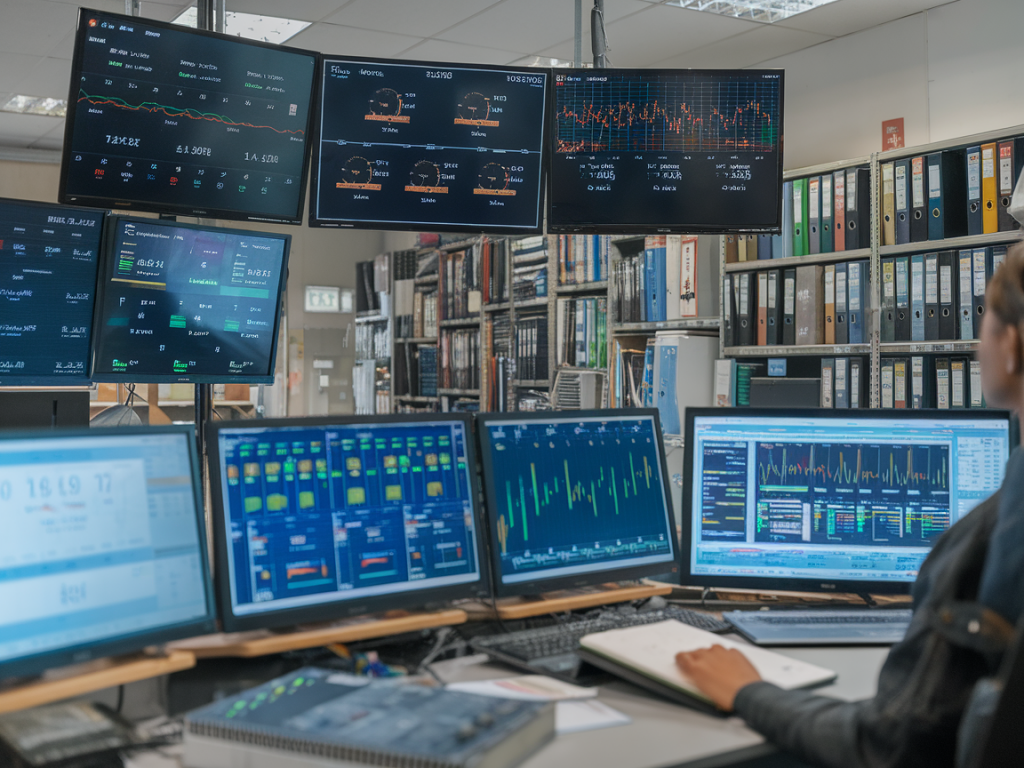
I’ve spent years watching teams drown in time-series telemetry: terabytes of sensor data streaming into lakes, dashboards overflowing with metrics, and engineers still caught off guard when a pump or motor fails. The irony is that more data rarely equals better predictions — what matters is the right data, processed in the right place, with models that respect operational constraints.
Why focusing on telemetry volume is the wrong battle
When I first dug into industrial telemetry projects, the immediate impulse was “collect everything.” Vibration at 10 kHz, temperature every second, full diagnostic logs, and debug traces — all stored forever. That approach gives you options, but it also gives you noise, storage costs, slow ML pipelines, and complicated labeling headaches.
Predicting equipment failure isn’t about hoarding raw samples. It’s about extracting signals that correlate with degradation and designing a flow that surfaces those signals early, reliably, and inexpensively. You can do that while dramatically cutting data volume by orders of magnitude.
Start with outcome-driven data selection
I always ask operators and maintenance teams three simple questions before touching sensors:
These constraints shape both sampling strategy and model choice. If a failure needs hours of lead time, you can sample more coarsely. If you need seconds, you push intelligence closer to the edge.
Edge preprocessing: compress where it counts
Pushing basic preprocessing to the edge is one of the most cost-effective levers. Instead of shipping raw waveforms, compute—and transmit—summaries and features that matter:
These operations are cheap on modern microcontrollers (ESP32, ARM Cortex-M, or industrial PLCs with scripting). Using on-device libraries like TensorFlow Lite Micro or edge runtime functions on AWS IoT Greengrass / Azure IoT Edge, you can emit kilobytes instead of megabytes per hour.
Event-driven telemetry beats blind polling
Polling at high frequency is wasteful. Instead, adopt event-driven reporting:
This pattern keeps long-term storage and dashboards manageable while guaranteeing high-resolution data is available when it matters for diagnosis.
Feature hashing, sketches, and smart compression
For fleets of heterogeneous devices or when raw categorical metadata balloons, techniques like feature hashing or Count-Min Sketches preserve predictive power while bounding size. Sketches are especially useful for summarising rare events across streams without storing every event.
Compression matters too: delta encoding, downsampling with anti-aliasing, and storing residuals (difference from a running baseline) reduce payload while preserving anomalies. In practice I’ve seen 5x–50x reductions with negligible model performance loss when teams adopt these approaches.
Model choices that respect operational constraints
Picking the right model is as much an engineering decision as a statistical one.
I’ve often started with simple, explainable models in production and added complexity only when they reached their limits. That gives teams confidence and reduces false positives — a frequent showstopper for adoption.
Labeling: the secret bottleneck
Good labels are expensive. In many industrial settings, “failure” is clear but the onset time is fuzzy. I recommend:
Weak supervision — using proxy labels from alarms, warranty claims, or past maintenance records — often gets you 80% of the way there at a fraction of the cost.
Monitoring, explainability, and feedback loops
Predictions are only useful if teams act on them. I build systems that prioritize clarity:
Visual tools like Grafana or Kibana combined with compact summaries let engineers and operators collaborate. I’ve found that when technicians can see the “why” behind an alert, acceptance and follow-up improve dramatically.
Practical architectures that scale
Here are three architectures I’ve used in the field, depending on constraints:
| Pattern | When to use | Pros | Cons |
|---|---|---|---|
| Edge-first | Low bandwidth, real-time needs | Low network cost, fast alerts | Model updates harder, limited compute |
| Hybrid | Distributed fleet, moderate connectivity | Good trade-off, scalable | Orchestration complexity |
| Cloud-heavy | Plenty of bandwidth, centralized ops | Easy model training, rich analytics | High cost, latency |
Operational tips I use on projects
In short, predicting equipment failures without drowning in data is less about collecting more and more about collecting smarter, compressing and summarising early, choosing models that match your operational reality, and building transparent feedback loops. The goal is to turn telemetry into timely, actionable intelligence — not an unmanageable lake of logs.

